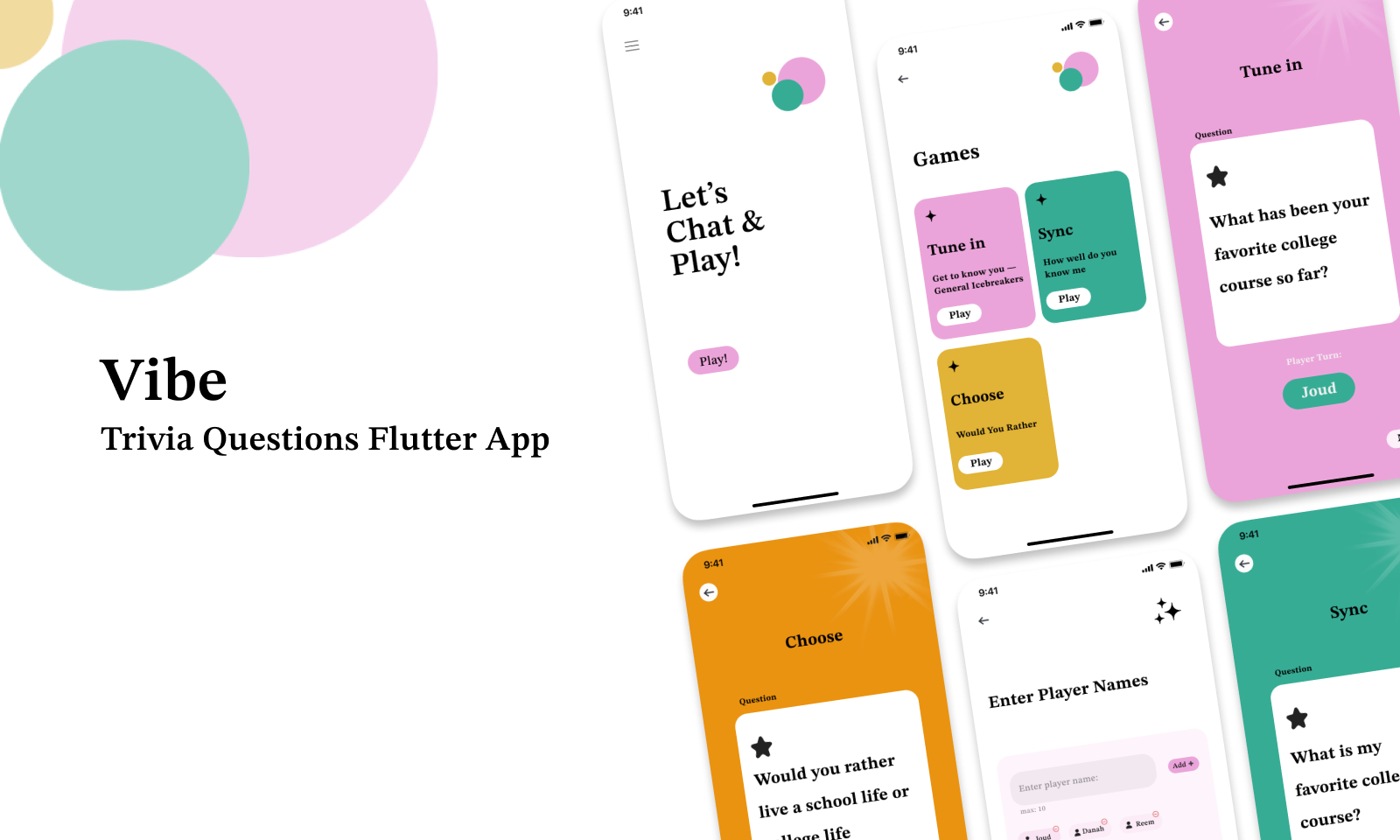
A fun group game app built for long university breaks — uses ChatGPT to generate custom questions across three game modes. Still in active development.
Vibe started as a spontaneous idea during a long university break when a group of friends wanted something to do. Rather than picking up a standard trivia app, the goal was to build something that generates fresh, contextually aware questions every session — so the game never feels like you've played it before.
The app uses the ChatGPT API to generate questions dynamically based on the selected game mode and difficulty. It's still being developed further, with plans to add multiplayer room support and custom question categories.
The immediate goal was to have something fun and polished enough to actually play with friends. The longer-term goal is to build it out into a proper multiplayer experience. This project also served as a practical way to learn how to integrate a live LLM API into a mobile app and handle the latency gracefully.
The app ships with three distinct modes: a trivia mode with factual questions, a "Would You Rather" style mode for group discussion, and a creative challenges mode that gives players silly tasks to complete. The ChatGPT prompt is tuned per mode to keep questions appropriate and fresh.
Rather than pulling from a static question bank, every session generates new questions via the ChatGPT API. This means the game never repeats and the questions can be made harder, funnier, or more creative on demand.
The app manages a smooth session loop: lobby screen → question display → answer reveal → next question → round summary. Loading states during API calls are handled with animated placeholders so the wait doesn't feel jarring.
The main challenge is latency. ChatGPT API calls take 1–3 seconds, which breaks the rhythm of a fast-paced game. Pre-fetching the next question in the background while the current one is being answered reduced the perceived wait time significantly, but it added complexity to the session state management.
Prompt engineering also turned out to be important — early prompts occasionally generated questions that were too long, too similar to the previous question, or formatted inconsistently. Tight prompt constraints with explicit output format instructions fixed most of this.
Integrating a live AI API into a real-time user experience taught me that latency is a design problem as much as a technical one. The solution isn't just to make the call faster — it's to design the UX around the delay so it doesn't feel like waiting.
Vibe is also the clearest reminder I have that the best way to stay motivated on a side project is to build something you actually want to use. I've shipped more features on this than on any class assignment, purely because I was excited to show it to friends.